Arctic Tracker / Glossary
Glossary
The CITES, IUCN, trade and taxonomy terms used across this site, defined once here. 72 entries, grouped by the area they belong to.
How this page was produced derived
Every entry above the last section is read at request time from arctic_api.glossary_term, the curated glossary in the deposit, and shown with its acronym and definition as recorded; the same terms are in the deposit as glossary_terms.csv. The last section, Terms this site uses, is written in the site's own code (src/lib/site-terms.ts) and is not part of the deposit. Nothing here is generated.
Conservation curated
The Red List category entries below are plain-language summaries, not the criteria. A category is assigned by applying IUCN's quantitative criteria. The ordinal scale this site scores movement on is LC, NT, VU, EN and CR, the one introduced with the 2001 revision. Why a category from an earlier system is not a point on that scale, and what it costs to say so.
- Appendix I
- CITES listing for species threatened with extinction. Trade is permitted only in exceptional circumstances and requires both import and export permits.
- Appendix II
- CITES listing for species not necessarily threatened with extinction, but trade must be controlled to avoid utilization incompatible with their survival.
- Appendix III
- CITES listing for species protected in at least one country that has asked other CITES Parties for assistance in controlling trade.
- CITES
- Convention on International Trade in Endangered Species of Wild Fauna and Flora. The primary international agreement ensuring that trade in wild animals and plants does not threaten their survival.
- CMS
- Convention on the Conservation of Migratory Species of Wild Animals (Bonn Convention). International treaty protecting migratory species across their range.
- CMS Appendix I
- Endangered migratory species requiring strict protection across their range. Parties must protect habitats and prohibit taking.
- CMS Appendix II
- Migratory species that would benefit from international cooperation for conservation and management.
- CoP
- Conference of the Parties. The decision-making body of CITES that meets every 2-3 years to review implementation and make decisions on species listings.
- Critically Endangered (CR)
- Species facing extremely high risk of extinction in the wild in the immediate future.
- Endangered (EN)
- Species facing very high risk of extinction in the wild in the near future.
- Extinct (EX)
- Species for which there is no reasonable doubt that the last individual has died.
- Extinct in the Wild (EW)
- Species known only to survive in cultivation, captivity, or as a naturalized population outside its historic range.
- iNaturalist
- Global biodiversity observation network and social platform where naturalists, scientists, and the public share observations of biodiversity.
- IUCN
- International Union for Conservation of Nature. Global authority on the status of the natural world and measures needed to safeguard it, publisher of the Red List.
- Least Concern (LC)
- Species evaluated by IUCN with low risk of extinction. Widespread and abundant taxa are included in this category.
- NAMMCO
- North Atlantic Marine Mammal Commission. Regional body for cooperation on conservation, management and study of marine mammals in the North Atlantic.
- Near Threatened (NT)
- Species close to qualifying for or likely to qualify for a threatened category in the near future.
- Vulnerable (VU)
- Species facing high risk of extinction in the wild in the medium-term future.
Trade curated
- Artificially propagated (A)
- Source code for plants artificially propagated for commercial purposes.
- Bones
- Animal bones including skulls, traded for various purposes including traditional medicine and crafts.
- Botanical garden (G)
- Trade purpose code for plant specimens destined for botanical gardens.
- Breeding in captivity (B)
- Trade purpose code for specimens used in breeding programs or artificial propagation.
- Captive-born (F)
- Source code for animals born in captivity (F1 or subsequent generations).
- Captive-bred (C)
- Source code for animals bred in captivity (Appendix II/III).
- Captive-bred (commercial) (D)
- Source code for Appendix-I animals bred in captivity for commercial purposes.
- Circus/Exhibition (Q)
- Trade purpose code for specimens used in circuses or traveling exhibitions.
- Commercial (T)
- Trade purpose code for commercial trade in specimens.
- Confiscated (I)
- Source code for confiscated or seized specimens.
- Educational (E)
- Trade purpose code for specimens used in educational programs and displays.
- Hair
- Animal hair including wool and fur, traded for textile and other uses.
- Hunting trophy (H)
- Trade purpose code for specimens taken as hunting trophies.
- Law enforcement (L)
- Trade purpose code for specimens used in law enforcement, judicial, or forensic purposes.
- Live
- Living specimens traded for zoos, aquariums, research, or private collections.
- Marine environment (X)
- Source code for specimens taken in marine areas not under any jurisdiction.
- Meat
- All meat parts and products from wildlife, traded for consumption.
- Medical (M)
- Trade purpose code for specimens used in medical or biomedical research.
- Personal (P)
- Trade purpose code for personal use, typically tourist souvenirs.
- Pre-Convention (O)
- Source code for specimens acquired before CITES provisions applied.
- Ranched (R)
- Source code for specimens from ranching operations.
- Reintroduction (N)
- Trade purpose code for specimens being reintroduced or introduced into the wild.
- Scientific (S)
- Trade purpose code for specimens used in scientific research.
- Scientific specimens
- Specimens preserved specifically for scientific research and education.
- Skin pieces
- Parts of skins including scraps, often used in leather or fur products.
- Skins
- Whole, raw or tanned animal skins used in trade, including furs and pelts.
- Specimens
- Whole animals, dead or alive, in the context of wildlife trade.
- Teeth
- Animal teeth traded for various purposes, including tusks and ivory from marine mammals.
- Trophies
- Hunting trophies including mounted specimens or parts kept as souvenirs.
- Unknown source (U)
- Source code used when the source of specimens is unknown.
- Wild (W)
- Source code for specimens taken from the wild.
- Zoo (Z)
- Trade purpose code for specimens destined for zoos.
Taxonomy curated
- Class
- Taxonomic rank below phylum and above order (e.g., Mammalia for mammals, Aves for birds).
- Common name
- Vernacular or colloquial name for a species in local language (e.g., Polar Bear for Ursus maritimus).
- Family
- Taxonomic rank below order and above genus (e.g., Ursidae for bears, Delphinidae for dolphins).
- Genus
- Taxonomic rank below family and above species. First part of the scientific name (e.g., Ursus for bears).
- Kingdom
- Highest taxonomic rank in biological classification (e.g., Animalia for animals, Plantae for plants).
- Order
- Taxonomic rank below class and above family (e.g., Carnivora for carnivorous mammals, Cetacea for whales and dolphins).
- Phylum
- Major lineage within a kingdom in biological classification (e.g., Chordata for vertebrates).
- Scientific name
- Binomial nomenclature using Latin to uniquely identify species (Genus species format).
- Species
- Basic unit of biological classification. The full scientific name consists of genus + species (e.g., Ursus maritimus).
Geography curated
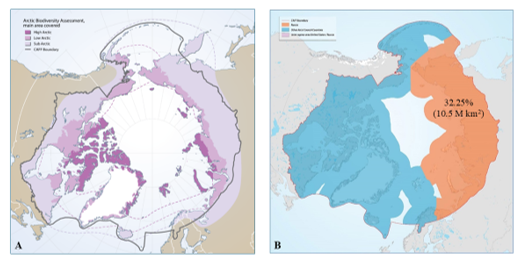
- Arctic region
- Circumpolar north including the Arctic Ocean and northern parts of Canada, Russia, USA (Alaska), Greenland, Norway, Sweden, Finland, and Iceland. Definition varies by context.
- Non-Party
- Country that has not joined CITES. Trade with non-Parties requires comparable documentation.
- Party/Parties
- Countries that have formally joined CITES and are bound by its provisions. Currently 184 Parties.
- Range states
- Countries where a species naturally occurs within its native distribution.
- Split-listing
- When different populations of the same species have different CITES appendix listings based on geographic location.
Data curated
- Catch data
- Harvest or hunting records, particularly from NAMMCO for marine mammals in the North Atlantic.
- Conservation assessment
- Formal evaluation of a species' conservation status, typically by IUCN Red List criteria.
- Importer/Exporter
- Countries involved in wildlife trade. Importers receive specimens; exporters send them.
- Population trend
- Direction of population change over time: increasing, stable, decreasing, or unknown.
- Reported quantity
- The amount of specimens declared in official trade documentation, which may differ between importers and exporters.
- Timeline events
- Significant conservation milestones such as CITES listings, IUCN assessments, or major policy changes.
- Trade records
- Individual documented transactions of wildlife trade, including species, quantity, countries, and purpose.
- Trade volume
- Total quantity of specimens involved in international trade over a specific period.
Terms this site uses curated
Words the site uses in a sense of its own. They are written in the site's code, not taken from the deposited glossary.
- Corpus
- The database this site and the paper read: the 43 species with their CITES listings, Red List assessments, trade and seizure records, as frozen for the paper. The deposit is the published copy of it.
- Binding (of a figure)
- A recorded link between a manuscript figure and the code that drew it, so the figure can be regenerated and checked. Confirmed when a named person has checked it; proposed until then.
- Red List Index
- IUCN's indicator of how the extinction risk of a set of species changes over time, counting only genuine category changes. The site borrows two of its rules (gates 1, 2 and 5) and does not compute the index itself.
- Gate (eligibility)
- One of five tests on the effectiveness page that a species must pass before its category movement is scored: an assessment since listing, no Data Deficient endpoint, both endpoints on the 2001 scale, both published after 2001, and a flag for genuine change. A species that fails one is shown with the first gate it fails, never with a direction.
- Human gate (G1 to G3)
- A point in the paper's pipeline where an author checks the output against its source before the next stage runs. Not the same thing as an eligibility gate: these check the data, the eligibility gates decide which species can be scored.
- First listing
- The first date a species became subject to CITES at any appendix, including coverage by a higher taxon such as Cetacea spp. The paper's rule, and the date every page measures from.
- Baseline
- The first global Red List assessment published in or after the year of the first listing. The start of a category movement.
- Endpoint
- The latest global Red List assessment. The end of a category movement.
- Category movement
- The change in Red List category between baseline and endpoint, on the scale LC, NT, VU, EN, CR. A description of what the categories did, not a measured change in extinction risk and not an effect of the listing.
- Status trajectory
- Category movement counting only the changes the IUCN judged genuine. The source carries no flag for that, so no page computes it.
- LR/cd
- Lower Risk, conservation dependent: a category of the 1994 system, discontinued in 2001 with no successor. The paper reads it as Near Threatened; the site places it on the timeline and does not score movement across it.
- Derived
- A value computed by code from a source whose digest is recorded. The label on a section says which values are of this kind.
- Curated
- A value entered or chosen by a named person rather than computed. Shown, and labelled, so it is never read as a table-checked fact.
- Withheld
- A value the site holds but does not print, because a licence forbids redistributing it (IUCN categories in the deposit) or because a review has not happened yet. The page says which.
- Unit dimension
- What a trade quantity measures: a count of specimens, a mass, a volume, an area, a length or a number of containers. Quantities are summed within one dimension and never across two.
- Exporter-reported, importer-reported
- Each CITES trade record is reported by the exporting or the importing Party. The same shipment can appear once from each side, so the two are shown apart and never added. Species-level counts use exporter-reported records.