All species / Eubalaena glacialis
Eubalaena glacialis
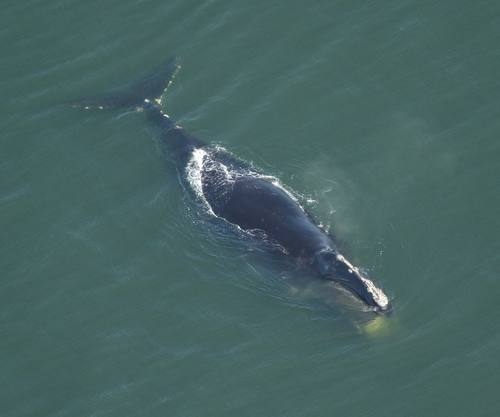
North Atlantic Right Whale · (Müller, 1776)
- Red List, global
- CR
- Critically Endangered, 2020
- First CITES listing
- I
- Appendix I, 1975
- CITES trade records
- 101
- 1981–2023 · exporter-reported
- Unit dimensions
- 3
- reported separately, never summed
- NAMMCO catch entries
- none
- NAMMCO reports a subset of marine mammals
- Seizure records
- 0
- reported taxon matches
One of 43: each square a species, coloured by its latest global Red List category, this one ringed. North Atlantic Right Whale is among the cetaceans.
In summary derived
Eubalaena glacialis, North Atlantic Right Whale, is placed in family Balaenidae, order Cetacea, class Mammalia. The earliest CITES listing row the corpus holds for it is Appendix I, dated 1975. The corpus records 1 dated listing row in total.
Its latest global Red List assessment is Critically Endangered, published 2020. It carries 4 earlier global assessments on the current scale.
The corpus holds 101 exporter-reported CITES trade records for it, from 1981 to 2023, reported across 3 unit dimensions. The most frequently recorded term is specimens: 59 records across 3 unit dimensions, of which 49 are measured in specimens. The corpus holds no NAMMCO catch records for it. No seizure record in the corpus is attributed to it.
Composed from 16 corpus fields, by template, with no model
species.classspecies.familyspecies.order_namespecies_catch.catch_totalspecies_iucn.is_globalspecies_iucn.statusspecies_iucn.year_publishedspecies_listing.appendixspecies_listing.listing_datespecies_seizure.*species_trade.dimensionspecies_trade.first_yearspecies_trade.last_yearspecies_trade.record_countspecies_trade.reporter_typespecies_trade.term
Each sentence is generated from the columns above and nothing else. The same corpus produces the same text every time. Where a field is absent the sentence is omitted rather than hedged.
Overview curated
Taxonomy entered by a named curator and versioned in the repository.
- Class
- Mammalia
- Order
- Cetacea
- Family
- Balaenidae
- First CITES listing
- 1975
- Global Red List status
- CRCritically Endangered, assessed 2020
- Regional status (Europe)
- CRRegional, 2023. Not the species status.
8 narrative sections for this species were machine-drafted and are not shown. No subject expert has reviewed and signed them.
Trade derived
CITES Trade Database v2025.1, extracted 13 June 2025.
Quantities are reported per unit dimension, per traded term, and per reporting side. These are not additive: kilograms and individual animals have no common unit, a live animal is not a carving, and an importer report and an exporter report are two accounts of one shipment rather than two shipments.
Figures below are exporter-reported.
- count in specimens
- 89 records, 88%
- mass in kg
- 10 records, 10%
- area in m²
- 2 records, 2%
Records per dimension. Not additive across units.
Trade over time
count measured in specimens
89 of 101 records carry a quantity in specimens. CITES leaves the unit blank to mean a count of the term.
| Term | Quantity | Records | Years | Source |
|---|---|---|---|---|
| specimens | 553 specimens | 46 | 1993– | W |
| bones | 16 specimens | 10 | 2002– | O |
| skin pieces | 263 specimens | 8 | 2000– | W |
| baleen | 11 specimens | 4 | 2011– | O |
| bone carvings | 4 specimens | 3 | 1990– | O |
| bones | 15 specimens | 3 | 2003– | W |
| carvings | 16 specimens | 2 | 1981– | not recorded |
| carvings | 2 specimens | 2 | 2004 | O |
| bone pieces | 3 specimens | 2 | 2013– | W |
| specimens | 20 specimens | 1 | 1988 | not recorded |
| bones | 13 specimens | 1 | 1993 | not recorded |
| jewellery | 1 specimen | 1 | 2022 | O |
Showing the 12 term and source combinations with the most records, of 18.
mass measured in kg
10 of 101 records carry a quantity in kg.
| Term | Quantity | Records | Years | Source |
|---|---|---|---|---|
| specimens | 2.41 kg | 8 | 2006 | W |
| bone pieces | 1 kg | 1 | 2002 | W |
| bones | 215 kg | 1 | 2004 | W |
area measured in m²
2 of 101 records carry a quantity in m². Area is the surface of the item traded as the Party reported it, for example a skin sample in square centimetres; every area unit is converted to m².
| Term | Quantity | Records | Years | Source |
|---|---|---|---|---|
| specimens | 0.00100 m² | 2 | 2003– | W |
CITES listings curated
CoP decisions, cross-checked against the appendix reported on trade records.
| Date | Appendix | Annotation | Status |
|---|---|---|---|
| 1975-07-01 | I | [GENUS listing Eubalaena spp.] Formerly included in Balaena spp. | first listing |
Convention on Migratory Species
Listed under CMS: Appendix I. Also covered by ACCOBAMS, which are separate instruments with their own annexes.
IUCN Red List derived
Assessment history. Scope is always stated: a regional assessment is not the species status.
- published global assessment
- regional assessment, never joined
Category movement since listing: deteriorated. Baseline EN in 2008, latest CR in 2020, an observed window of 12 years. This is the direction of change between two Red List categories. It is not a status trajectory and it is not an effectiveness result, because no genuine-change flag exists in the source and no counterfactual is available. How this is defined
| Year | Category | Meaning | Scope | Status |
|---|---|---|---|---|
| 2023 | CR | Critically Endangered | Europe | current for this scope |
| 2020 | CR | Critically Endangered | Global | current for this scope |
| 2020 | CR | Critically Endangered | Global | a republished version of the 2020 assessment |
| 2018 | EN | Endangered | Global | |
| 2012 | EN | Endangered | Global | |
| 2008 | EN | Endangered | Global | |
| 2007 | CR | Critically Endangered | Europe (scope corrected) |
Reported catch derived
NAMMCO catch exports dated 11 June 2025. A reported zero is stored as zero, distinct from an unknown.
No NAMMCO catch records for this species. NAMMCO reports on a subset of marine mammals, so an absence here is expected for most species and does not mean no catch occurred.
Illegal trade seizures derived
Seizure records whose reported taxon resolves to this species.
No seizure in the compilation names this species. Matching is on the taxon the source reported, case aside. Across the whole compilation, 225 of 919 rows match one of the 43 species and the rest name other taxa.
Quantities are unitless. The source gives no date or place, so the table shows the product and the reported taxon.
No seizure records attributed to this species.
References withheld
Machine-proposed bindings. Shown only where an expert has signed the profile and the binding is live.
No references are recorded for this species: none is shown, and none was machine-proposed for review.
Timeline curated
Curated events. Those with no corroborating table in this database are marked.
| Date | Event | Type | Corroboration |
|---|---|---|---|
| 2023 | IUCN Red List Assessment (2023) | iucn_assessment | checked against iucn_assessments |
| 2020 | IUCN Red List Assessment (2020) | iucn_assessment | checked against iucn_assessments |
| 2018 | IUCN Red List Assessment (2018) | iucn_assessment | checked against iucn_assessments |
| 2015-04-09 | CITES Trade Suspension | cites_suspension | curated |
| 2012 | IUCN Red List Assessment (2012) | iucn_assessment | checked against iucn_assessments |
| 2008 | IUCN Red List Assessment (2008) | iucn_assessment | checked against iucn_assessments |
| 2007 | IUCN Red List Assessment (2007) | iucn_assessment | checked against iucn_assessments |
| 2003-06-15 | CITES Trade: specimens | cites_trade | checked against cites_trade_records |
| 2002-06-15 | CITES Trade: specimens | cites_trade | checked against cites_trade_records |
| 2000-06-15 | CITES Trade: specimens | cites_trade | checked against cites_trade_records |
| 1975-07-01 | Listed in CITES Appendix I | cites_listing | checked against cites_listings |
Events marked curated are not matched by a row in a corroborating table, either because none applies or because the table holds no such row, and rest on the curator alone. They are shown, and marked, rather than presented as equivalent to a table-checked fact.